
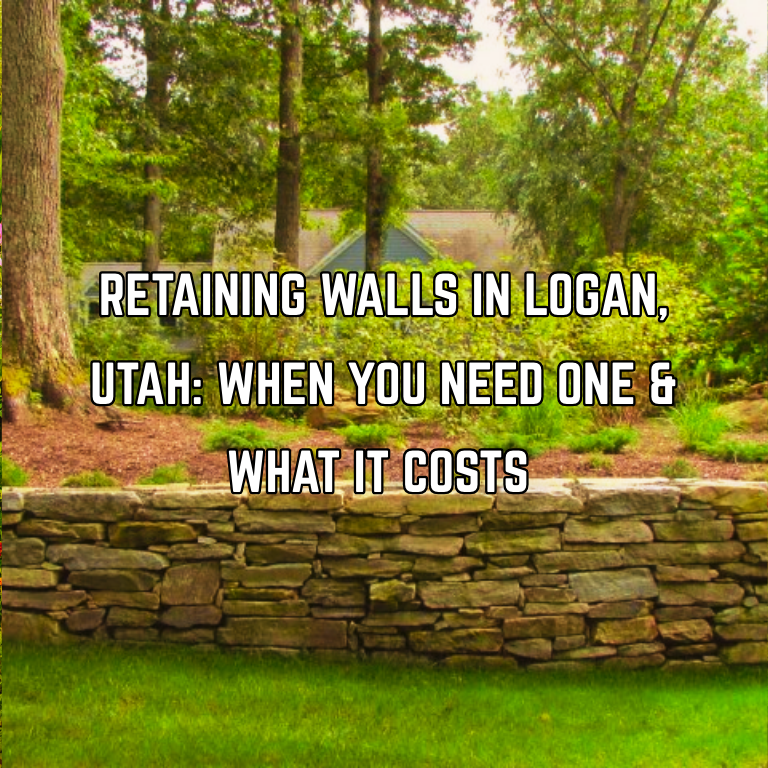
If your yard slopes, erodes after snowmelt, or feels unusable because of elevation changes, a retaining wall may be the solution. In areas like Logan and throughout Cache Valley, retaining walls are not just decorative — they’re often essential for stability and function.
Retaining walls are structures designed to hold or retain soil behind it. Whether you’re leveling part of your yard, preventing erosion, or creating terraced landscaping, the right wall can completely transform your property.
But not all retaining walls are the same — and choosing the wrong type can lead to costly failure.
When Do You Need Retaining Walls?
Homeowners in Northern Utah often need retaining walls when:
- Their yard has a steep slope
- Soil erosion becomes visible after heavy rain or snowmelt
- They want to create flat usable space
- A driveway or patio needs support
- Landscaping sits on uneven grades
Because of Utah’s freeze-thaw cycles and clay-heavy soils in some areas, proper wall design is critical.
Types of Retaining Walls
Over the years, many materials have been used to build retaining walls. Each has advantages and limitations.
Timber or Railroad Tie Walls
Wood is often the cheapest option upfront. It’s easy to install and works for short-term projects. However, treated timbers have a shorter lifespan, especially in climates with moisture and temperature swings like Utah. As wood decomposes, the wall loses structural integrity.
Natural Stone or Boulder Walls
Stone walls can look beautiful and organic. However, they are labor-intensive and expensive to install. Over time, stones can shift, erode, or create gaps where weeds and rodents settle.
Poured Concrete Walls
Cast-in-place concrete walls are strong and rigid. They can be veneered with brick or stone for aesthetics. However, they do not flex with ground movement and freeze-thaw cycles, which can cause cracking. They are also typically one of the more expensive options.
Segmental Retaining Walls (SRW)
Segmental Retaining Walls (SRWs) use interlocking concrete blocks stacked without mortar. These modular systems are durable, flexible, and widely used in both residential and commercial projects.
Because the blocks lock into place and create a slight setback as they stack, they form what is known as a gravity retaining wall.
Gravity Wall vs. Geogrid Reinforced Wall
Choosing the correct type depends on several factors:
- Soil type (sand, clay, mixed soil)
- Height of the wall
- What sits above the wall (driveway, pool, structure)
- Slope angle above and below
- Available installation space
Gravity Retaining Walls
Gravity walls rely on their own weight and block setback to hold soil in place. They are typically used for shorter walls and lighter loads.
As blocks stack and interlock, the natural backward lean (setback) helps resist soil pressure. For many residential landscaping projects in Logan, this is a practical and cost-effective solution.
Geogrid Reinforced Retaining Walls
For taller walls or heavier loads, reinforcement is required. Geogrid is a mesh material placed between layers of block and extended back into the soil. This reinforces the soil mass behind the wall, creating a stronger structure.
In simple terms:
The blocks + the geogrid + the reinforced soil all work together as one large, stable unit.
In some cases, alternative reinforcement like soil nails or earth anchors may be needed, which often requires engineering design.
What Does a Retaining Wall Cost in Logan, Utah?
Cost depends on:
- Wall height
- Length
- Material selection
- Drainage requirements
- Soil conditions
- Reinforcement needs
Short gravity walls are typically more affordable. Taller reinforced walls cost more due to excavation, grid materials, and engineering.
However, a properly built retaining wall adds usable land, improves drainage, and increases property value — making it a long-term investment.
What Keeps a Retaining Wall From Failing?
Retaining walls don’t fail because of the blocks — they fail because of poor design.
Proper stability depends on:
- Correct base preparation
- Adequate drainage behind the wall
- Proper backfill material
- Reinforcement when needed
- Compaction of soil layers
Water pressure buildup is one of the biggest causes of retaining wall failure. That’s why drainage systems behind the wall are essential in Utah’s climate.
Why Retaining Walls Are Popular in Cache Valley
In Logan and surrounding areas, retaining walls are often used to:
- Create terraced landscapes
- Fix grading issues
- Support driveways
- Add flat lawn or patio areas
- Improve curb appeal
They turn sloped, unusable land into functional outdoor living space.
Frequently Asked Questions About Retaining Walls
What is the cheapest retaining wall to build?
Timber retaining walls are usually the cheapest upfront option. However, they have a shorter lifespan and may require replacement sooner than concrete or block walls.
What can you do instead of a retaining wall?
In some cases, grading the slope, installing erosion control systems, or using terraced landscaping can reduce the need for a full retaining wall. The right solution depends on slope severity and soil stability.
Are concrete retaining walls cheaper than blocks?
Poured concrete walls are often more expensive due to labor and materials. Segmental block retaining walls can be more cost-effective and flexible, especially for residential applications.
What is the strongest type of retaining wall?
Geogrid reinforced retaining walls are among the strongest because they integrate reinforcement into the soil mass behind the wall, increasing stability for taller structures.
What is the most inexpensive retaining wall?
Short gravity walls using modular concrete blocks are often the most cost-effective long-term solution because they balance durability and installation efficiency.
What keeps a retaining wall from falling?
Proper base preparation, adequate drainage, correct backfill material, reinforcement (when needed), and professional installation prevent retaining wall failure.
Conclusion
Retaining walls do more than hold soil — they create usable space, solve drainage problems, and add structure to your landscape. In Logan and throughout Cache Valley, the right retaining wall can transform a difficult slope into a functional, attractive feature that lasts for decades.
Whether you need a simple gravity wall or a reinforced system for a larger project, proper design and installation are what ensure long-term stability. A well-built retaining wall doesn’t just improve your yard — it protects it.