

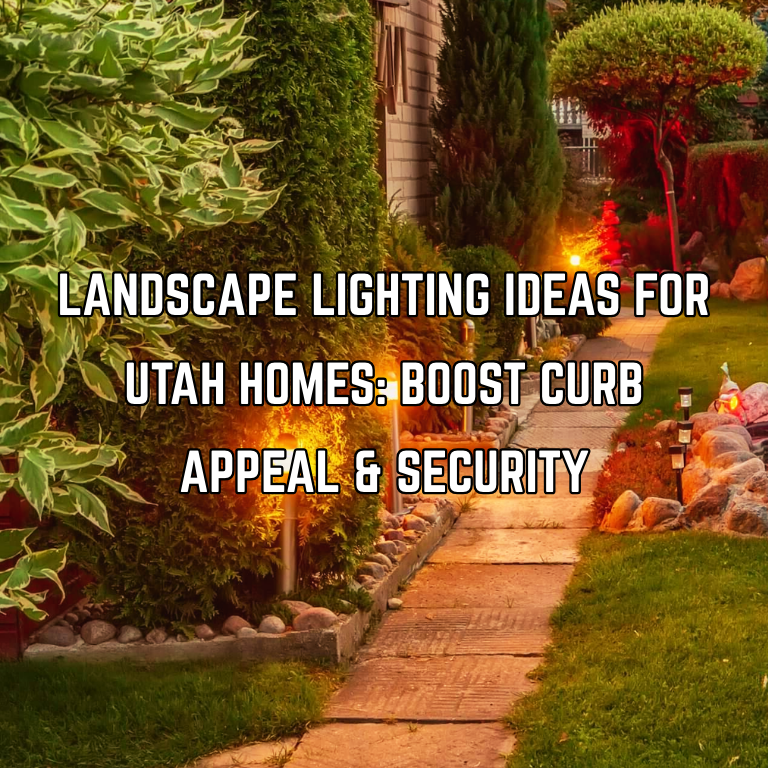
When the sun sets in Utah, your home shouldn’t fade into darkness. In Logan, Cache Valley, and across Northern Utah, the difference between a property that looks ordinary at night and one that feels refined, secure, and welcoming often comes down to intentional landscape lighting.
When designed correctly, landscape lighting does not appear harsh or overpowering. Instead, it subtly enhances architectural details, highlights trees and pathways, and adds depth to your outdoor space without overwhelming the neighborhood. The goal is refinement — not brightness for the sake of brightness.
Unfortunately, many homeowners approach outdoor lighting by simply adding fixtures without a clear plan, which often results in uneven illumination or distracting glare.
Why Landscape Lighting Is More Than Just Decoration
Landscape lighting enhances security, safety, and ambiance — but those words don’t fully capture its impact.
Think about winter in Utah. Long nights. Snow reflecting light. Icy walkways. Early sunsets.
Without proper lighting:
- Entry steps become hazards
- Pathways disappear
- Architectural features flatten into shadows
- Backyards become unusable after 5 PM
With a well-designed lighting system:
- Your home gains depth and dimension
- Walkways feel safe and clearly defined
- Trees and stone features create visual drama
- Outdoor spaces become usable year-round
Lighting transforms how your property functions — not just how it looks.
How to Light Up Your Landscape the Right Way
A common question homeowners ask is: How do I light up my landscape properly?
The answer is not “add more fixtures.”
The answer is layering.
A professional lighting layout typically includes:
- Architectural accent lighting
- Tree uplighting
- Downlighting (moonlighting effect)
- Path lighting
- Subtle wash lighting on walls or fences
The goal is balance. You want light and shadow working together — not a yard that looks like a parking lot.
What Is the Best Type of Landscape Lighting?
For Utah homes, low-voltage LED landscape lighting (12V systems) is almost always the best option.
Here’s why:
- LEDs are energy-efficient and long-lasting
- Low voltage (12V) is safer than line voltage
- Fixtures produce less heat
- Systems are easier to maintain
- They allow more precise light control
Modern LED fixtures also provide consistent brightness without frequent bulb replacement, which is especially helpful in colder climates.
Why Is Landscape Lighting 12V?
Standard household power is 120 volts.
Landscape lighting uses a transformer to convert that power down to 12 volts (sometimes 15V for longer runs).
Low-voltage systems are preferred because they:
- Minimize electrical risk
- Reduce energy consumption
- Offer easier installation flexibility
- Allow safer wiring in outdoor environments
In residential properties, 12V provides more than enough power while maintaining efficiency and safety.
Avoiding the Biggest Mistake: Over-Brightness
One of the most common design issues is creating “hot spots.”
That happens when:
- Fixtures are too bright
- Too many lights are installed
- The beam angle is too narrow
- The fixture is positioned incorrectly
Great landscape lighting should feel soft and natural.
Most residential applications work best within:
- 100–200 lumens for path lighting
- 200–400 lumens for shrubs and small trees
- 400–700 lumens for large trees or focal points
Brightness should highlight — not overpower.
What Is the Best Wattage for Landscape Lighting?
With modern LED technology, wattage is much lower than traditional halogen systems.
Typical residential LED usage:
- 3W–7W for path lights
- 5W–9W for accent or uplights
Instead of focusing only on wattage, pay attention to:
- Lumen output
- Beam spread
- Color temperature
- Placement
These factors determine quality more than raw power.
Choosing the Right Color Temperature for Utah Homes
Color temperature dramatically affects how your home feels at night.
For most Utah homes, the ideal range is:
2700K–3000K
This warm white tone complements:
- Natural stone
- Brick exteriors
- Wood accents
- Landscaping materials
Cool white lighting (4000K+) often looks harsh and commercial — especially when reflected off snow.
Warm lighting feels inviting and residential.
What Voltage Is Best for Landscape Lighting?
For almost every residential landscape lighting project, 12V is best.
However, if your property has:
- Long wire runs
- Multiple fixture zones
- Larger yards
You may need heavier gauge wire (12-2 or 10-2) to prevent voltage drop.
Voltage drop causes dim lights at the end of the line — something proper planning avoids entirely.
How Landscape Lighting Improves Security
Security lighting doesn’t mean floodlights blasting your yard.
Strategic lighting eliminates dark areas around:
- Garages
- Side yards
- Driveways
- Entry points
When you remove shadows, you remove hiding spots.
A layered lighting system combined with timers or motion sensors increases visibility without sacrificing aesthetics.
Maintenance: What Homeowners Often Forget
Landscape lighting systems need occasional care.
Especially in Utah’s climate, maintenance includes:
- Cleaning lenses from dust and debris
- Adjusting fixtures as plants grow
- Checking wiring connections annually
- Repositioning lights to avoid glare
As shrubs and trees mature, fixtures may need slight adjustments to maintain proper angles.
Maintenance is minimal — but important.
Planning Your Landscape Lighting System
If you’re starting from scratch, begin with a simple mapping exercise:
- Identify focal points (entryway, large trees, stone features)
- Outline pathways and transitions
- Highlight gathering spaces
- Balance brightness across the yard
Good lighting design is intentional. Every fixture should serve a purpose.
Final Thoughts
Landscape lighting isn’t just about making your home visible at night.
It’s about creating atmosphere.
Improving safety.
Enhancing architecture.
Increasing perceived value.
When installed correctly using low-voltage LED fixtures, warm color temperatures, and balanced layering, landscape lighting becomes one of the most impactful upgrades you can make to a Utah home.
Subtle. Strong. Refined.
That’s what great outdoor lighting should feel like.